Walk into any conversation among tea lovers and you’ll find two camps glaring at each other over their cups. The loose leaf purists insist tea bags are an insult to the leaf. The tea bag pragmatists point out that nobody carries a strainer to a 9:30 am stand-up meeting. Both camps are right, and both miss the point. Loose leaf and tea bags aren’t rivals; they’re tools for different moments. At TeaQure we sell most of our blends both ways, so we have no reason to talk you out of either. What we can offer is an honest comparison, flavour, freshness, cost, and convenience, so you can decide which belongs in your kitchen, which in your office drawer, and why the answer is usually both.
First, What’s Actually Different?
The real difference is usually the leaf inside the bag.
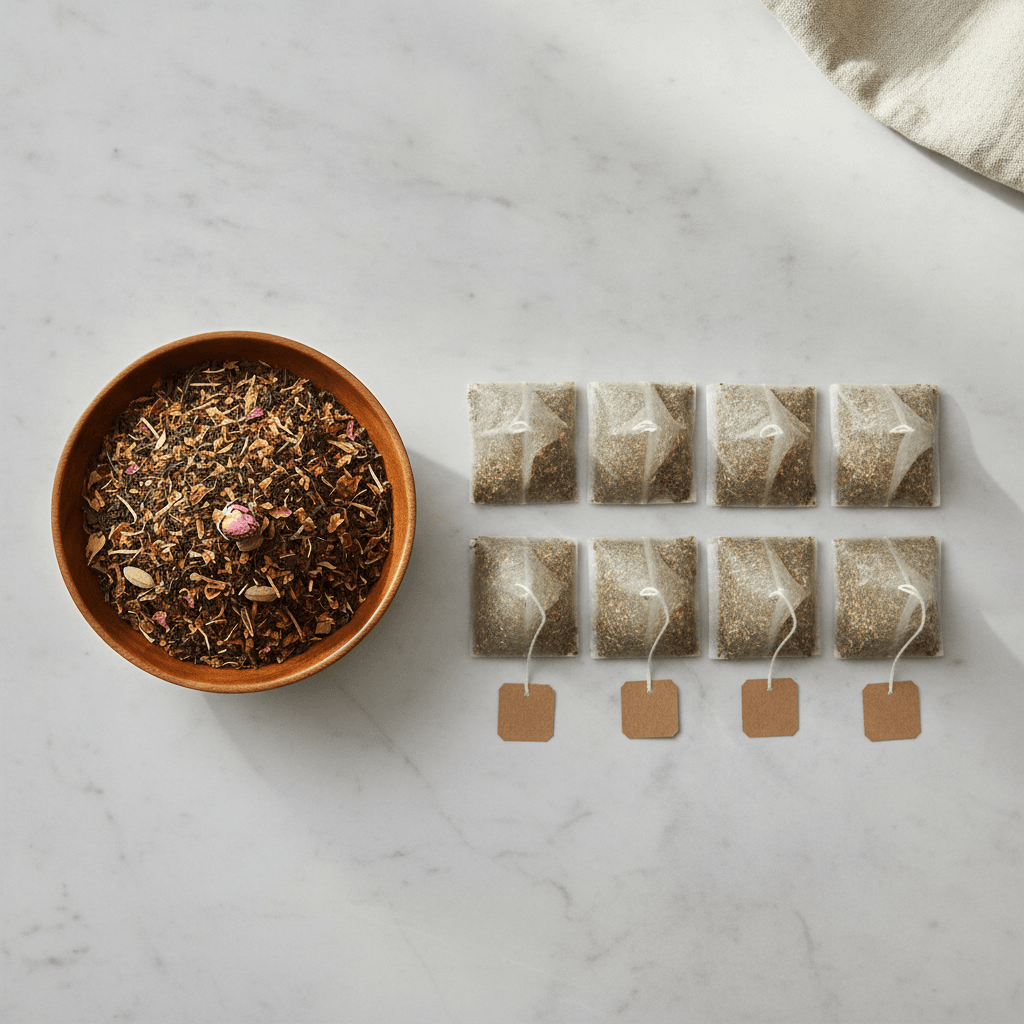
Loose leaf tea generally means larger, more intact leaves. Whole or lightly broken leaves keep more of their essential oils and unfurl fully in hot water, releasing flavour in layers. Traditional mass-market tea bags have often used “fannings” or “dust”, tiny particles left over from processing, which brew fast and strong but with less nuance.
That gap has narrowed. Better tea bags today, including the roomier bags we use for our 25N ranges, hold proper broken-leaf grades of the same blends we sell loose. A good modern tea bag beats stale loose leaf every time, but leaf grade for leaf grade, loose still holds a structural edge.
Flavour and Control: Loose Leaf Wins
If taste matters above all, loose leaf is the stronger choice, for three reasons.
- Room to unfurl. Leaves floating free expand fully and give up their character gradually. Even a roomy bag constrains this a little.
- You control the dose. One level teaspoon for a light cup, a heaped one for a bold cup. A bag is a fixed dose decided at the factory.
- Re-steeping. Good loose leaf gives two or three worthwhile steeps in a sitting, each with its own personality. Most tea bags fade after one.
Loose leaf rewards attention. That’s its joy and, on a rushed Tuesday, its inconvenience.
Convenience: Tea Bags, No Contest
Now for the tea bag’s home turf: no strainer, no measuring spoon, no infuser to fish out and rinse at 11 pm.
- Office and travel. A few bags in your laptop sleeve mean decent tea anywhere with hot water: trains, hotel rooms, meeting rooms.
- Speed. Cup, bag, water, three minutes, done. There’s a reason the tea bag conquered the world.
- Consistency. Every bag holds the same dose, so Monday’s cup tastes like Friday’s. Zero guesswork.
- Cleanup. Lift, drip, bin. That’s the entire washing up.
If your tea moments mostly happen away from home, bags aren’t a compromise; they’re the correct tool.
Freshness, Storage, and Cost per Cup
Keeping tea fresh
Tea is happiest whole and miserable when exposed. Larger loose leaves have less exposed surface area, so they lose aroma more slowly than finely broken leaf, provided you store them in an airtight tin away from light, heat, moisture, and the spice shelf. Stored this way, loose leaf stays lively for months.
Tea bags trade a little longevity for a different protection. Individually enveloped bags shield each serving until the moment you use it, helpful in humid coastal cities, though an opened box of loose bags can go stale faster than a sealed tin. Rule of thumb: buy what you’ll finish in two to three months, either way.
Cost per cup: closer than you think
Sticker prices mislead here. A pouch of loose leaf looks costlier than a box of bags, but count the cups. A 100 gram pouch at roughly 2 grams a cup gives about 50 cups, and re-steeping whole leaves even once effectively makes that 75 to 100. A 25-bag box gives 25 cups, maybe a few more with light re-steeps.
Per cup, then, loose leaf is usually the economical choice, often by a wide margin. With tea bags you pay for packaging, portioning, and convenience, a fair trade when convenience is exactly what you need. Don’t assume bags are the budget option; usually it’s the reverse.
How to Brew Each One Well
Whichever side you buy, technique decides the cup.
- Loose leaf: 1 teaspoon (about 2 grams) per 200 ml cup. For green teas, rest boiled water 2 to 3 minutes so it drops to 80 to 85 degrees Celsius, steep 2 to 3 minutes, strain fully. Black teas take water just off the boil for 3 to 4 minutes.
- Tea bags: same temperatures, but check at 2 minutes since smaller leaf brews faster. Remove the bag on time and never squeeze it; squeezing forces out the harshest, most tannic liquid.
- Both: start with fresh, filtered water and warm your cup first.
The Honest Verdict: Buy Both, Deploy Them Differently
Without hedging: loose leaf for your best cups, tea bags for your busiest ones. Keep loose leaf at home for slow mornings, weekend pots, and guests, where flavour, control, and cost per cup all favour it. Keep bags in your office drawer and travel kit, where convenience is the whole game. This is why TeaQure sells the same blends both ways. It’s not loose leaf versus tea bags; it’s kitchen tea versus desk tea.
Frequently Asked Questions
Is loose leaf tea really better than tea bags?
For pure flavour, usually yes: larger leaves keep more aromatic oils, unfurl fully, and re-steep well. But it depends on what’s inside the bag. A quality bag with proper broken leaf, like our 25N range, brews a genuinely good cup, while stale loose leaf brews a poor one. Leaf quality matters more than format.
Which is cheaper, loose leaf or tea bags?
Per cup, loose leaf almost always wins. A 100 gram pouch yields around 50 cups, and re-steeping whole leaves stretches that towards 100, while a 25-bag box gives about 25 cups. Bags cost more per cup because you’re paying for portioning and packaging, worthwhile when convenience genuinely matters to you.
Do tea bags go stale faster than loose leaf?
It depends on the packaging. Finely broken leaf has more exposed surface area, so once a box is opened, bags can fade faster than whole loose leaves in an airtight tin. Individually enveloped bags stay protected until used. Either way, store tea away from light, heat, moisture, and spices, and finish it within a few months.
Can I re-steep tea bags the way I re-steep loose leaf?
You can, but expect less. Smaller leaf particles give up most of their flavour in the first steep, so a second cup from the same bag is noticeably lighter, fine for a gentle evening brew. Whole loose leaves hold back more, which is why they deliver two or three satisfying steeps.
Stock Your Kitchen and Your Desk Drawer
The easiest way to settle this debate is to try both. Browse everything at our shop and pick a pair: Lemon Ginger Green Tea loose for home and its twin, the Lemon Ginger Green Tea 25N Tea Bags, for work. Prefer calmer? Do the same with our Tulsi Ginger or Darjeeling green blends; most TeaQure favourites come in both formats. Free shipping over ₹499 makes stocking both sides of your tea life easy.